
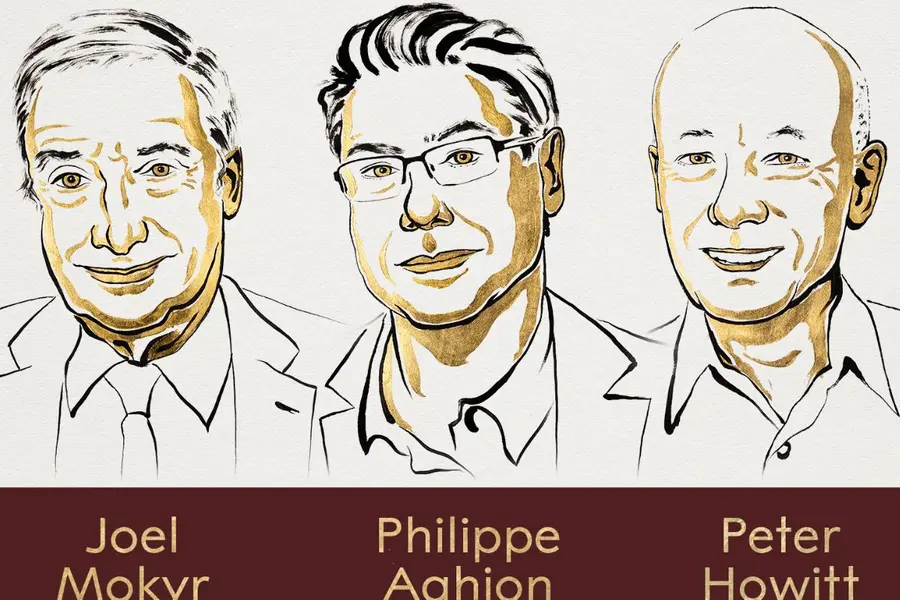
Stockholm, October 13 (IANS): The Nobel Prize in Economic Sciences 2025 has been awarded to Joel Mokyr, Philippe Aghion, and Peter Howitt for their groundbreaking contributions to the understanding of long-term economic growth and technological innovation. This announcement marks the conclusion of this year’s Nobel Prize season.
Recognizing Innovation and Growth
According to the Royal Swedish Academy of Sciences, Joel Mokyr received the award for his research identifying the prerequisites for sustained growth through technological progress, while Philippe Aghion and Peter Howitt were honoured for developing the theory of sustained growth through creative destruction.
Their work has fundamentally shaped modern economic thought, offering insights into how innovation drives economic development and how technological change influences competition and productivity.
The Concept of Creative Destruction
Referring to their landmark 1992 article, the Nobel Committee explained that Aghion and Howitt’s model illustrates the process of “creative destruction” — a phenomenon where new innovations replace outdated technologies and products, propelling economies forward.
“The innovation represents something new and is thus creative. However, it is also destructive, as the company whose technology becomes passé is outcompeted,” the Committee noted.
The model highlights that investment in research and development (R&D) plays a crucial role in sustaining economic growth, although the intensity and impact of such investment can vary depending on market conditions and time periods.
Joel Mokyr’s Contribution
Economic historian Joel Mokyr was recognised for identifying the historical and institutional factors that enable technological progress to translate into sustained economic growth. His work bridges the gap between economic theory and history, explaining how cultural and intellectual developments influence innovation.
The Legacy of the Laureates
The Nobel Committee praised the laureates for deepening the understanding of how innovation, competition, and policy interact to shape modern economies. Their combined research offers policymakers valuable tools to promote innovation-driven and inclusive growth.
The Nobel Prize in Economic Sciences, established in 1968 by Sweden’s central bank, Sveriges Riksbank, in memory of Alfred Nobel, carries a cash award of 11 million Swedish kronor. The formal award ceremony will be held in Stockholm on December 10, the anniversary of Alfred Nobel’s death.